
Forgiveness, Fortitude, and Fakery in 'Wake Up Dead Man'
The first shot of Our Lady of Perpetual Fortitude in Wake Up Dead Man gives you all of the indication of how the film will go.
An imposing Gothic church looms in the woods. Rain sluices down the windows. The pews are heavy, traditional, deeply Catholic. Antiquated, unmoving. A flickering light casts a silhouette over the altar, slowly darkening the back wall as the figure stalks down the nave. Then you see the altar.
On the rear wall, a shadow as stark as soot from a votive candle outlines the place where a cross once hung. It couldn’t be more obvious if they spelled it out in subtitles.
There is no Christ to be found in Our Lady of Perpetual Fortitude.
So, how divine can this murder really be?
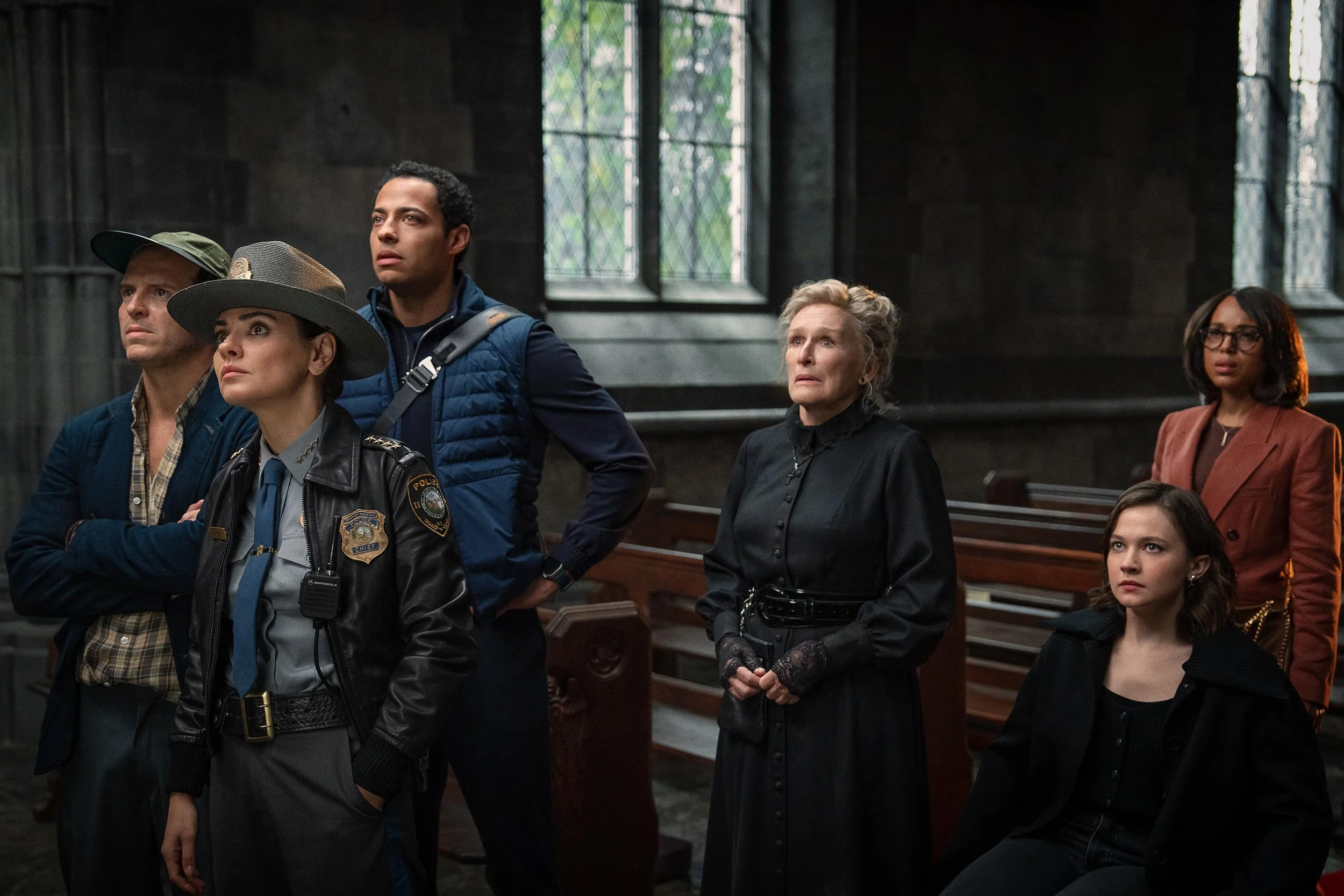
Still of Msgr. Wicks’ congregation (Scott, McCormack, Close, Spaeny, Washington) and Police Chief Geraldine Scott (Kunis).
Wake Up Dead Man is the third installation of the Knives Out series.
A young Catholic priest, Reverend Jud Duplenticy (Josh O’Connor), is assigned to a struggling parish led by a firebrand pastor, Monsignor Jefferson Wicks (Josh Brolin). Things are off from the get-go with both Wicks and his congregation, a quintet of followers devoted less to their faith in the church than in Wicks himself. Father Jud disagrees with Wicks’ incendiary gospel, his bullying towards newcomers, his manipulative treatment of his flock. When Wicks turns up dead in the middle of Good Friday mass, all fingers point to the young priest.
A locked room. An impossible crime. Enter Benoit Blanc, here to save the day with quick thinking and elegant menswear.
Except he doesn’t.
Benoit Blanc seems cowed in this movie. His entrance is delayed, his scenes secondary, his energy subdued. Our Lady of Perpetual Fortitude and its enigmas swallow him up from the first scene, and he struggles to break out of the shadows. After the breezy nouveau riche fever dream of Glass Onion, Wake Up Dead Man places Blanc in a whole different realm. And that is the point.
I attended an early screening of this film during the 41st Miami Film Festival GEMS, and as a special introduction, Knives Out director and creator Rian Johnson spoke about how each of the three films embodied a different trope of mystery novel genre, from the cozy manor murders of Agatha Christie to the Gothic enigmas of Edgar Allan Poe. Wake Up Dead Man certainly fits right in with the latter.
The setting itself is darker than the previous films. Wake Up Dead Man is set in Chimney Rock, an appropriately bleak small town in upstate New York– a far cry from the glamorous Grecian island in its predecessor The Glass Onion. And that’s just the start. In true heart-beating-under-the-floorboards fashion, this movie created a climate of unease from the beginning, with Josh Brolin dominating as the inflammatory, larger-than-life Msgr. Wicks. Even in death, he literally haunts the narrative, a martyr to his loyal flock and a wraith to those trying to detangle his legacy. Wake Up Dead Man was deeply unsettling, with some of the most disturbing scenes I’ve seen in a whodunnit and jumpscares that nearly startled me out of my seat. Johnson leans heavily into the themes of Gothic mysteries– the missing fortune, the madwoman, the darkness hiding behind every corner– and executes them perfectly.
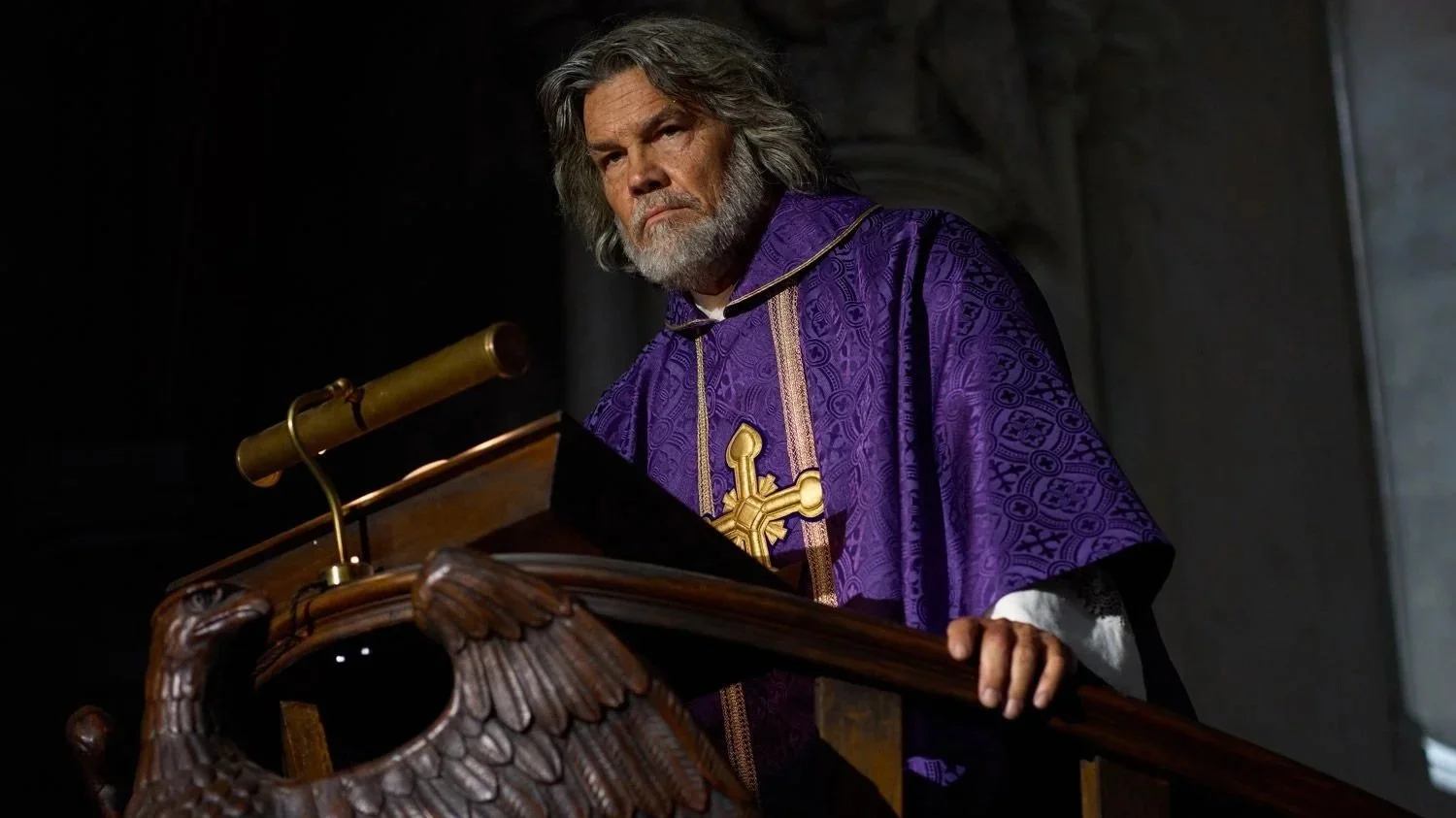
Still of Monsignor Jefferson Wicks (Brolin).
Speaking of perfection, Josh O’Connor delivers a truly fantastic show in his role as Father Jud Duplenticy. A reformed boxer-turned-priest, he does his best to infuse light into the darkness overtaking Our Lady of Perpetual Fortitude, despite the cards stacked against him. Just as with Knives Out’s Marta Cabrera, and as with Blanc himself, he is simply kind. He cares about this parish he did not choose, these people who do not hide their distrust of him. He cares, and he tries. Over and over again, he gets up and tries again. Among the already star-studded cast, Josh O’Connor plays a perfect foil to both Josh Brolin’s Monsignor Wicks and Daniel Craig’s Benoit Blanc.
My main qualm with this film though, as an enthusiast of the Knives Out series, is the lack of scenes with the dapper detective.
Daniel Craig’s character has become iconic for his fashionable looks, quirky demeanor, and absurd “Foghorn Leghorn” accent. His charm, humor, and overwhelming compassion stands out in a genre plagued by cold PIs who care for nothing but the case and their own ego (don’t even get me started on that BBC Sherlock adaptation). While Blanc is, of course, on the case in Wake Up Dead Man, he is a shell of himself, overshadowed in the meagre screentime he does have. However, while I was disappointed with Blanc getting sidelined in his own series, Father Jud more than stepped up to the plate.
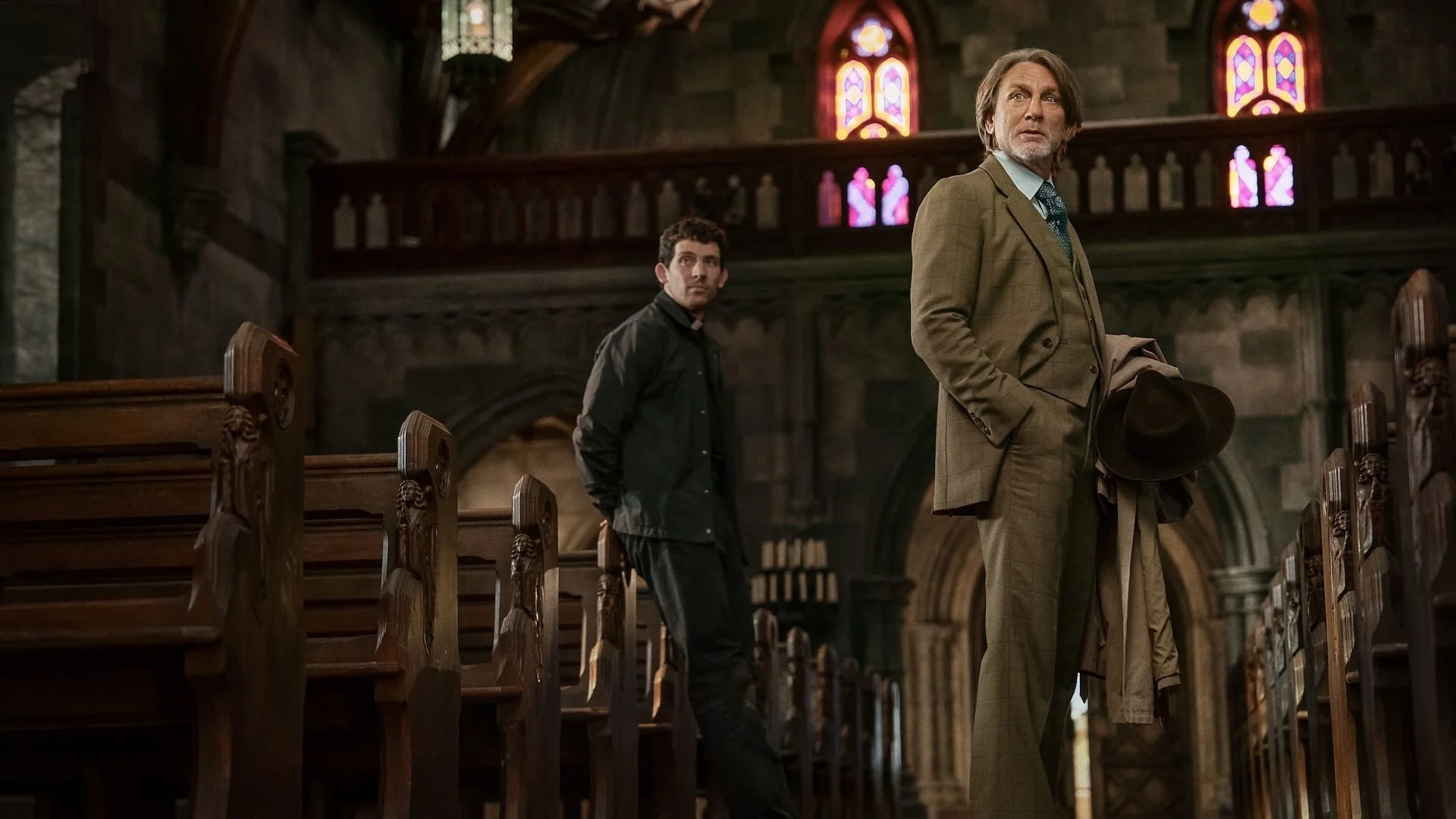
Still of Our Lady of Perpetual Fortitude, showing Rev. Jud Duplenticy (O’Connor) and Benoit Blanc (Craig).
The greatest strength of the Knives Out series is its commitment to showing the good of humanity.
Don’t get me wrong, countless characters do truly terrible things to each other. But Wake Up Dead Man treats every character with dignity and grace and so much compassion, even when they may not deserve it. In a world where religion is weaponized to corrupt and spread hate, to watch a young, hopeful priest embody teachings of love and community and forgiveness was heartening. The final scene of Glenn Close’s Martha Delacroix with Blanc in the church brought tears to my eyes and left the theatre silent.
In a world that is increasingly cynical and individualistic, it is so refreshing to see characters who care.
Wake Up Dead Man is also a movie about fakery. About the way people shroud themselves in religion and reputation and presentability politics, and pretend they are not acting with violence against others. How they lie and scheme and corrupt, and how they hide it. Just take a look into the house of Dr. Nat Sharp (Jeremy Renner), one of the parishioners.
At first glance, the house is colonial, charming and kitschy, plastered wall-to-wall with his ex-wife’s favored butterfly motif. Painfully normal, begging the viewer not to look closer. And beneath the bright colors and gauzy wings lurks an unfinished basement familiar to the childhood nightmares of anyone who grew up in an old house in the Northeast. What laid at the bottom of those creaking wooden steps and flickering bulbs still makes my stomach churn to remember (spoiler: it’s one of the grisliest scenes I have seen in recent cinema).
The often glaringly obvious metaphors in Wake Up Dead Man do not do it a disservice. Johnson does not shy away from making his story and opinions clear, or from using heavy handed imagery and meta conversations to do so. This movie is a commentary on the weaponization of religion and the deterioration of community, a modern story seen across time and told through a Gothic lens. It isn’t always perfect– even as he pays homage to the narrative themes of the Gothic genre, Johnson is also upfront when they don’t work. Our Lady of Perpetual Fortitude isn’t even a Gothic church– it’s Neo-gothic. As one character says to Father Jud, “We are in New York, after all.”
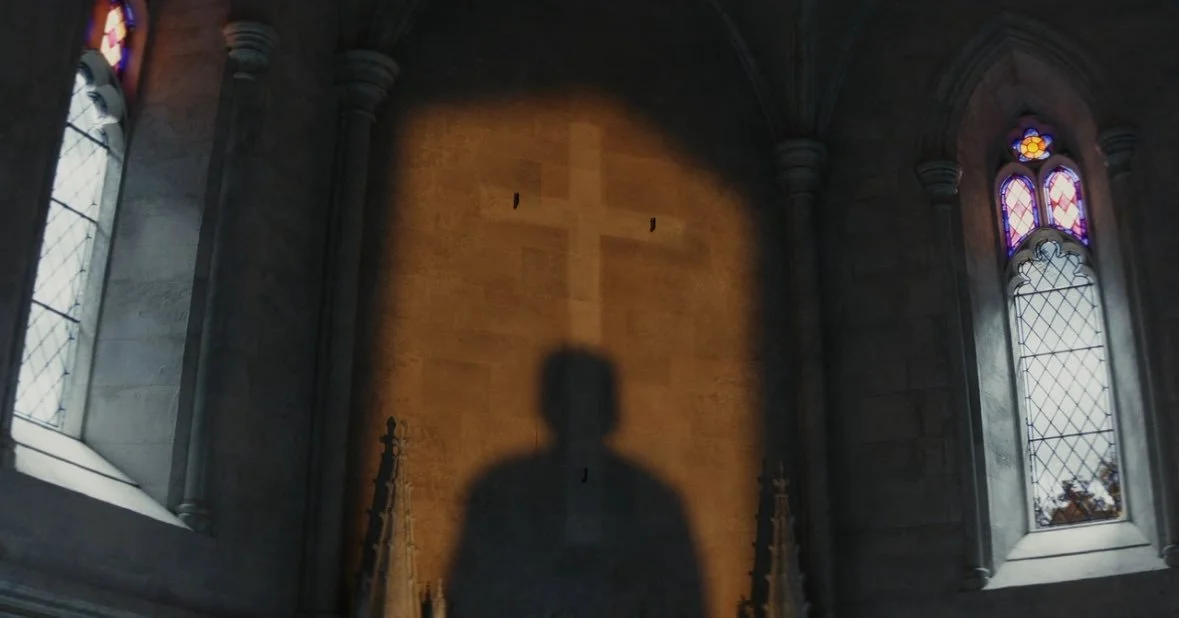
Still of Our Lady of Perpetual Fortitude.
There could be no conclusion to Wake Up Dead Man without addressing the cross.
The cross of Our Lady of Perpetual Fortitude, in its absence, becomes a character in itself. Its infamous destruction at the hands of Msgr. Wicks’ mother Grace haunts the narrative (and Wicks) just as she does. It is gravitational, pulling each scene towards it like a collapsing star. It begs you to acknowledge the void it leaves, for you to realize what is happening is wrong.
Wake Up Dead Man is a film that demands you pay attention. So do it. Take note of what is there and what is not. Listen to the gap between what is said and what is done. Of who closes their doors and who opens their arms. Everything is important. Everyone matters.
The curtains are blue for a reason.