
‘Return to Silent Hill’ should be a return to the film drawing board
Note: there will be spoilers ahead for Return to Silent Hill.
The hills sure are silent, and matter of fact, so are the rounds of applause.
I’ve had the pleasure to watch Christopher Gans’ Return to Silent Hill, a psychological horror movie that attempts to take a different spin on the timeless classic survival psych horror videogame, Silent Hill 2.
I say pleasure, because it is always a pleasure to watch movies in the theater with friends. I say “attempts” because Gans’ direction of this movie clearly shows it is not meant to be a 1:1 adaptation of the beloved game.
I’ll lay out my biases right now for transparency. I love the Silent Hill videogames. I love composer Akira Yamaoka’s music. Hell, I love this franchise so much I went to see Yamaoka live, and I’ve read the novel adaptation of the first Silent Hill game.
So of course, when trailers were shown and fans got the inkling that this was not going to be faithful to the games, I too was disappointed.
But alas, this is not the first time nor the second time Silent Hill has been attempted on the silver screen, as shown by Silent Hill: Revelation (2012) by MJ Bassett, a direct sequel to Silent Hill (2006) by…Christopher Gans.
Both of these movies—strictly from the metrics from critics—have uh, not done so well; as seen by Gans’ first approach scoring 34% on Rotten Tomatoes and with Bassett’s attempt scoring a 4.9 out of 10 on IMDB.
So, in short, Gans has experience with filming the Silent Hill franchise, or rather a loose, controversial adaptation of it.
I’ll give credit where credit is due. The cinematography in some of these scenes is simply breathtaking…as if someone suffocated me with a rag.
The first shots of James waltzing into town really sells the fixed camera angles that made the games so terrifying. The ritual scene in the sewers is feverishly intense and packed with tension and angst that gets you sitting-up in your seat.
I also have so much love for the framing of the scene when James interrupts Mary and her “family friends’” meeting in their apartment; where through a shrine the audience can faintly make out the outline of the seal of Metatron. It adds to the feeling of a hidden, sinister reality underneath the bright shine of the apartment.
But some shots feel cheesy and half-baked. The title card being a pan-up into the sky feels so cartoonishly out-of-touch, and don’t get me started on the horrid, epileptic mess which was the film’s interpretation of the closet scene between James and Pyramid Head. The constant panning and screaming coupled with intense lighting, if executed well, could have been a phenomenal scene. But alas, it was not.
Jeremy Irvine had a difficult task in making James believably appear to be suffering from the psycho-supernatural effects of Pyramid Head and the town’s magic, but on the screen it just looks ridiculous.
Irvine’s acting aside, the cuts and editing of that scene feel so choppy and very much miss its target of a transcendental moment, instead landing into the Saw franchise’s schtick of seizing spasms subbing for decent filming.
On acting though, I think the cast really did try to sell the script they were given. Did some moments feel a little vanilla? Yes. But Irvine’s acting had its strong points, notably the tender moment of sadness as James comforted Mary on her deathbed. The moments of feverish shock and horror throughout the movie were great exhibitions of Irvine’s skill.
Similarly, Hannah Emily Anderson should be applauded due to her range in the film. She felt real, confident, and natural in the wily ambiguity that was the character of Maria. As Mary, she was both dreamy in her “perfect girlfriend” role with James but also realistically obnoxious when it came to the secrecy she held about the cult. And as Laura, she managed to portray a very selling depiction of a paranoid trauma victim, and her spin on the character—while different from the game version of Laura, is still an enjoyable experience to watch.
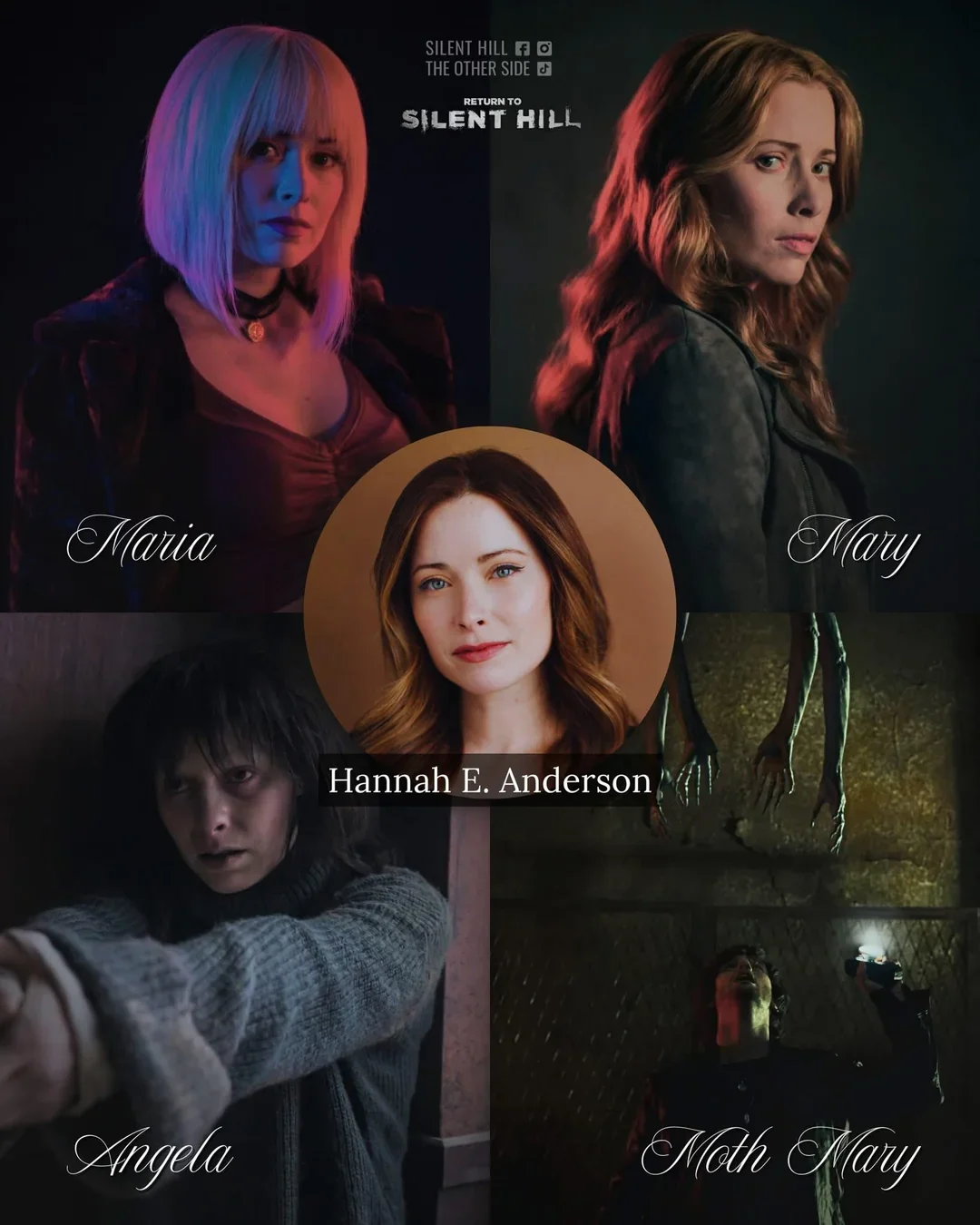
An edited graphic of Anderson’s roles in the film | Photo via r/SilentHill subreddit
But about those three roles…what an incredibly stupid plot point. Original canon aside, the introduction of Angela at the cemetery then becomes nonsensical when you factor in that Angela has no reason to be there in the first place since she is supposed to be Mary. Angela has no need to move or stack bodies as she had requested from James.
Sure, chalk it up to screenwriters taking a creative experiment to compress Mary’s traumatic upbringing into a personified character, but this then brings up the issue that Angela’s character is delegated to something that James needs to “save”, bringing in an offensive take to survivors of assault– that they need a hero.
Speaking of side characters, what the hell happened to Eddie? The character never shows up again in the entirety of the film. You know, one of the primary characters, the one-fourth of the original game? His whole arc ceases to exist after his introduction.
And yes, the humble watcher can chalk this up as a mysterious horror movie that leaves just enough ambiguity to let you “connect the dots”. But, this movie lacks a lot of cohesion. Ambiguity is great in art when it allows for creative theories to be backed by evidence of the art itself. This whole film seems to lack enough foundation to even write theory essays on.
For example, James being able to levitate and fly up to Mary? Yes, the town is supernatural. Yes, non-euclidean geometry is integral to Silent Hill. But to my knowledge, it has never given “ordinary” characters like James the ability to weaponize magical physics. A nitpick? Sure. But what I want to compromise on is the idea of artistry.
I, like many people, was not terribly impressed by this film.
However, I still think Christophe Gans should be commended for giving the franchise a second shot. Silent Hill has not had the best luck in terms of film reception, but it is a franchise which can stand to gain from more mediums of exposure, unlike its long-standing rival Resident Evil.
To Gans’ credit, the film is not wholly bad. The set design is phenomenal, the lighting is gorgeous, and Akira Yamaoka nails it again with the sound track. A lot of cameramen, set designers, gaffers, and more came together to make this film, and that is appreciated. Still, I think this film could have been massively improved.
And seriously, as a community, do we need to send the guy death threats? Does Gans really deserve his own Otherworld?
As in the Variety interview, Gans seems adamant about adapting another Silent Hill film. If true, then, in my restless reviews I’ll see that theater…AMC Sunset Place.