
I'm Not Clueless Anymore
I was perhaps the sole person in the audience who couldn’t quote the film by heart.
It’s one thing to grow up with Clueless in your back pocket, to be able to throw around “You're a virgin who can’t drive,” and not just understand the reference — but say it with gumption, to actually mean it.
It’s a whole different thing watching it through fresh eyes three decades later.
And while I laughed at the devastatingly humorous one-liners and chirps from the quirky characters on-screen because they were so outrageous, everyone around me — from an 11-year-old in front of me, to my friend beside me, to the middle-aged women behind me — were laughing like they had just watched it for the very first time.
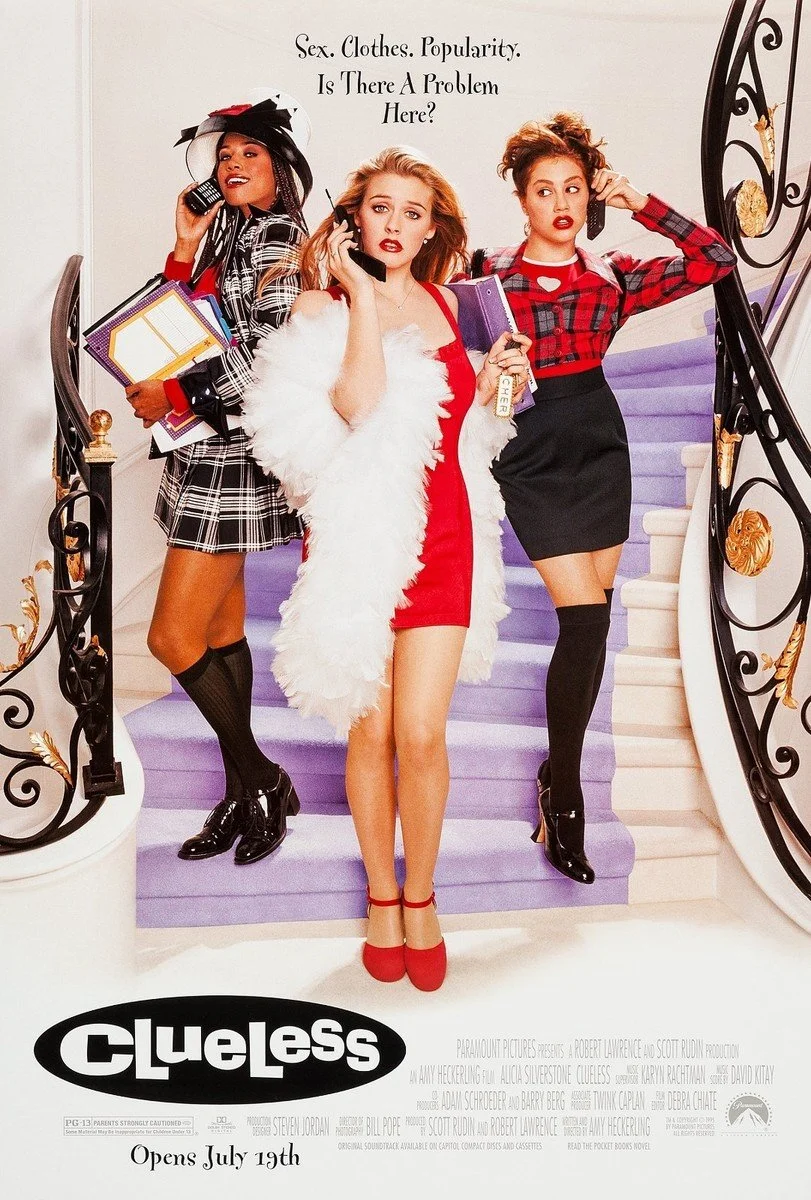
Theatrical poster for ‘Clueless’ (1995).
At the 41st Miami Film Festival GEMS, at the 30th Anniversary showing of the cult classic Clueless, the whole theater buzzed with a kind of communal nostalgia that pulled even the newcomers (me) into its all-consuming orbit.
Within the first few minutes, as Cher was piecing together her perfect yellow plaid ensemble (that shouldn’t have worked but somehow fit her and the moment perfectly), I realized something. Clueless wasn’t just a movie from 1995.
It’s a cultural event that refuses to age.
Maybe that’s because the film itself never learned how to behave its age. Or maybe because the crowd didn’t either. Everyone reacted with the kind of delighted ferocity you usually only see at concerts when the opening chords of a beloved song drop.
People didn’t just watch the film — they participated in it.
That’s when it dawned on me: this wasn’t nostalgia. It was customary. A ritual.
Every beat — from Cher’s outfits, Tai’s makeover arc, Paul Rudd’s face being illegally symmetrical (and borderline delicious, but I digress) — landed with the precision of punchlines the audience had been rehearsing for years. But even for me, the Clueless novice, there was something electric about being absorbed into a collective inside joke I had never heard before.
Like being welcomed into a secret society that has long been awaiting my arrival.
But I guess that’s how it works, coming late to a classic — you’re simultaneously an outsider and instantly initiated.
And as Cher navigated the chaotic teen politics of Beverly Hills High with the earnest confidence of someone who truly believes she can fix everyone’s life with a great wardrobe and an even greater outlook on life, I wasn’t just entertained — weirdly, I was moved.
Because beneath the camp and the quips and the impossibly shiny ’90s lip gloss, Clueless isn’t really about teen romance or popularity.
It’s about girlhood.
Mona May, the costume designer from Clueless, explained the method of bringing that balance to life: “There was a lot of invention, people dressing high and low.” Part of the costumes’ charm was its bold blend between inaccessibility and something an average high school girl could find in her closet.
It’s why Alaïa dresses walked alongside jeans that looked thrifted. Because if there’s one thing I’ve learned from being a woman, it’s that we’re never just one thing — and Clueless captured that essence perfectly.
Initially, Clueless wasn’t set to be a big production — it was a primarily female cast based on Jane Austen’s Emma with Amy Heckerling, a woman, directing. In a time when film was painfully a male-managed and dominated industry, Clueless threatened the status quo.
But audiences loved it. It was a force.
It was (and still is) about the way girls figure themselves out — loudly, messily, hilariously — and how that journey somehow still feels familiar, even when the world around us has changed entirely.
The beauty of Clueless, I’ve found, is simple. “[It’s] girls finding their authentic selves, and being okay in [their] skin and having fun,” May concluded.
By the time the credits rolled, the entire theater erupted in applause. Loud, thunderous, raucous applause. Though my hands found their way to each other and joined in the noise, I didn’t clap because I had grown up with Cher Horowitz or because I’d memorized the lines. I didn’t clap for the sake of nostalgia.
I clapped because I finally understood why everyone else had.