
Eternity is the movie of the year.
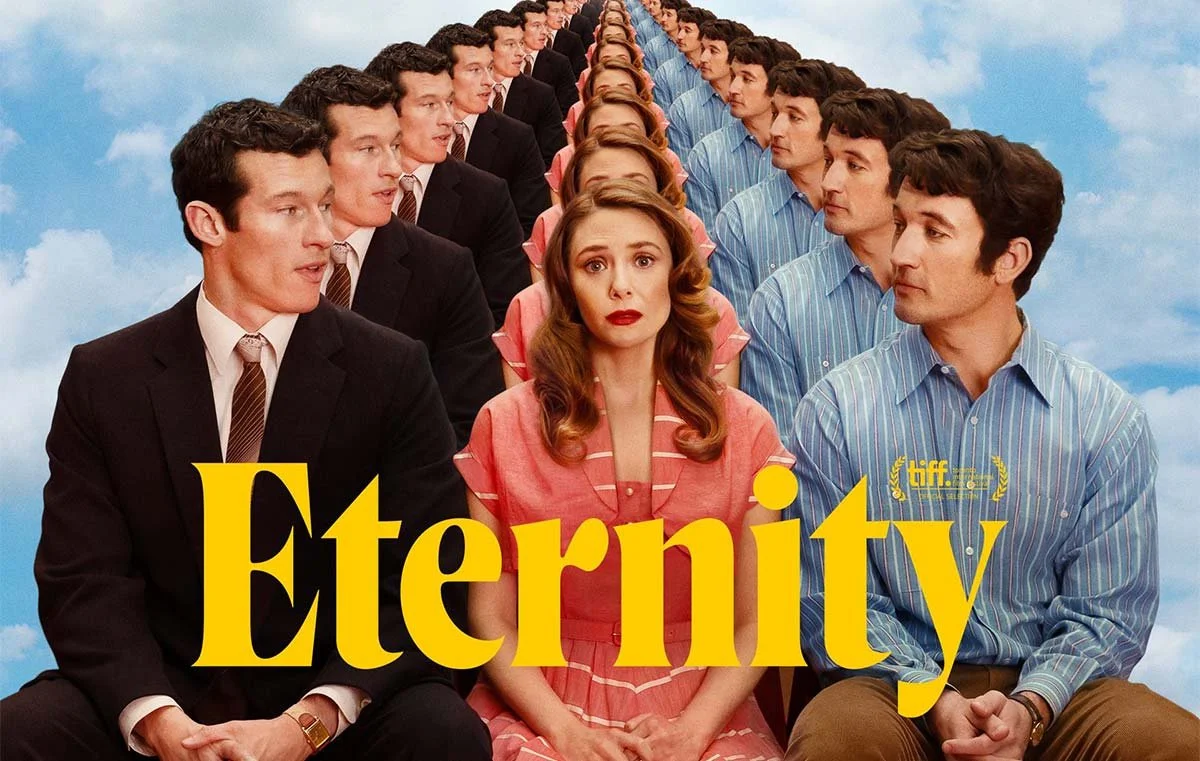
Official poster for ‘Eternity’ (2025).
Eternity doesn’t just tell a story — it yanks you by the collar into one.
So if you haven’t seen it for yourself, let me sell you on the most deliriously ambitious and emotionally literate film to hit theatres this year.
Not the loudest. Not the flashiest.
But the one that gets under your skin and refuses to leave.
Because here’s the thing about Eternity: it isn’t content with entertaining you.
It wants to undo you.
At its core, Eternity follows Joan and Larry, husband and wife of over six decades — and Luke, Joan’s late husband, a man who still haunts both their lives — as they navigate the thin, trembling line between the world of the living and the world that waits after. When death comes to collect Larry and then Joan, with Luke having waited in the fractures of the in-between for Joan to join him, decisions must be made. Hearts must be broken.
Eternity must be chosen.
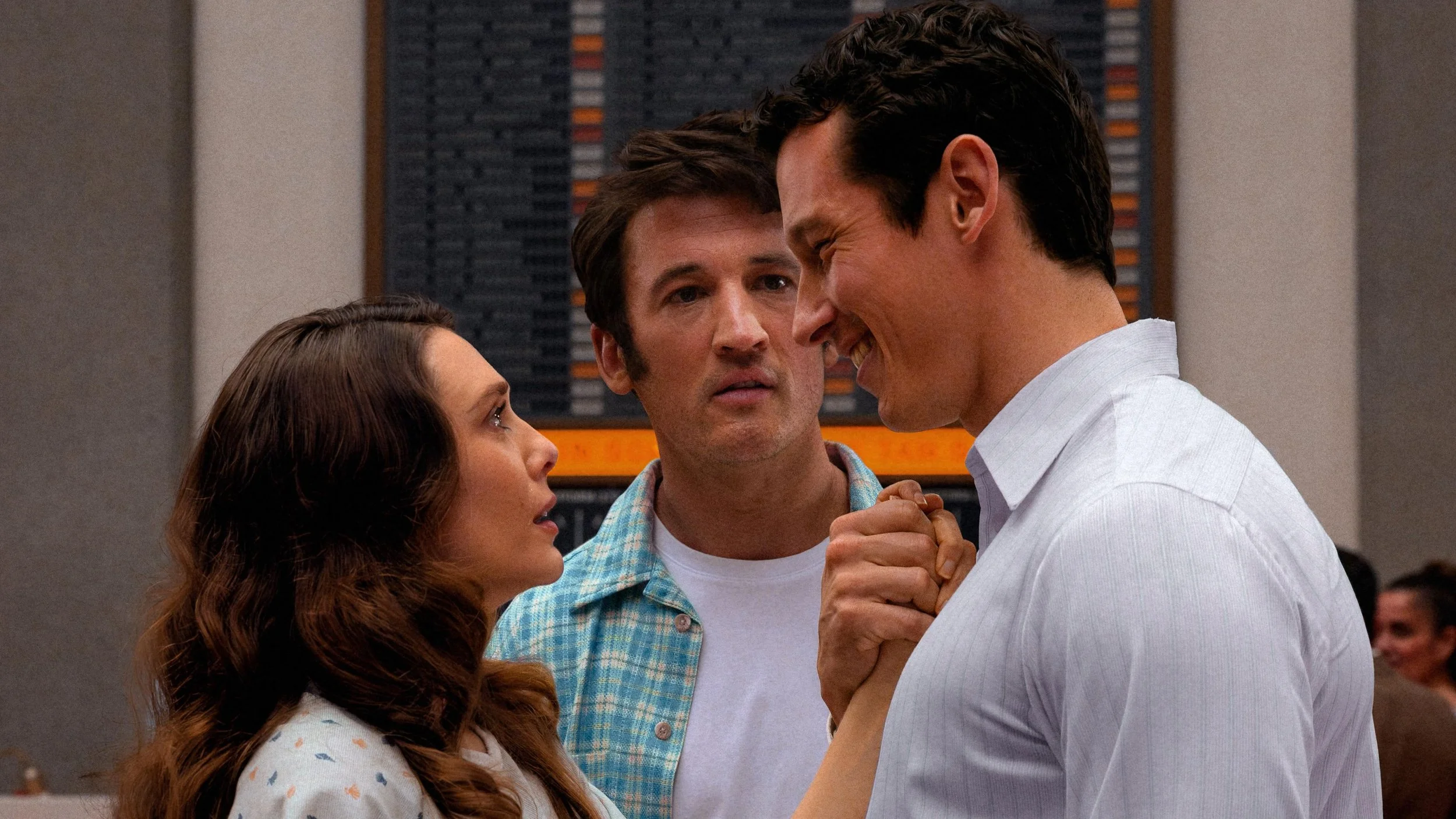
Elizabeth Olsen, Miles Teller, and Callum Turner as Joan, Larry, and Luke
Their collective reality has shifted in ways none of them can fully understand, and each is forced to confront the choices they made in the past, the promises they broke, and the versions of themselves they hoped time would forget. It’s part romance, part ghost story, part emotional excavation, all bound by the humors of plain old human ridiculousness. It’s a film about the people we can’t let go of, even when life insists we should.
Where one story ends, another begins.
A common theme throughout the film is that endings are inescapable. Everything that matters is ephemeral. You can’t die twice, and you only live once. If there are regrets in your life, words left unsaid, people left unkissed, it will bleed into your afterlife. It will haunt like a bigfoot-sized shadow. And somewhere in the tightrope walk between wanting more and fearing what comes next, this film discovers the quiet, aching beauty of an ending.
It’s tender without being soft, brutal without being cruel, romantic without being delusional. Eternity is a movie that feels like it was carved out of every moment you never confessed hurt you.
It is, in every sense, a film that knows exactly what it’s doing to you. It doesn’t waste your time; it reveres it.
In the age of three-hour epics and multiverse migraines, Eternity clocks in with the confidence of a story that doesn’t need excess to prove a point.
This is a film that understands real life’s favorite contradiction: Nothing lasts forever — and that’s exactly why we care. That’s why it matters.
Every scene is a choice, each line a knife, every nihilistic one-liner a reminder of humanity, and every beat of silence bears the weight of an elephant.
It’s not about the spectacle, though its retro-style grading is gorgeous. It’s about the emotional geometry between people who love each other, lie to each other, hurt each other, and still choose each other in their own flawed, human ways. Because all anyone wants is to be loved unconditionally in spite of their flaws.
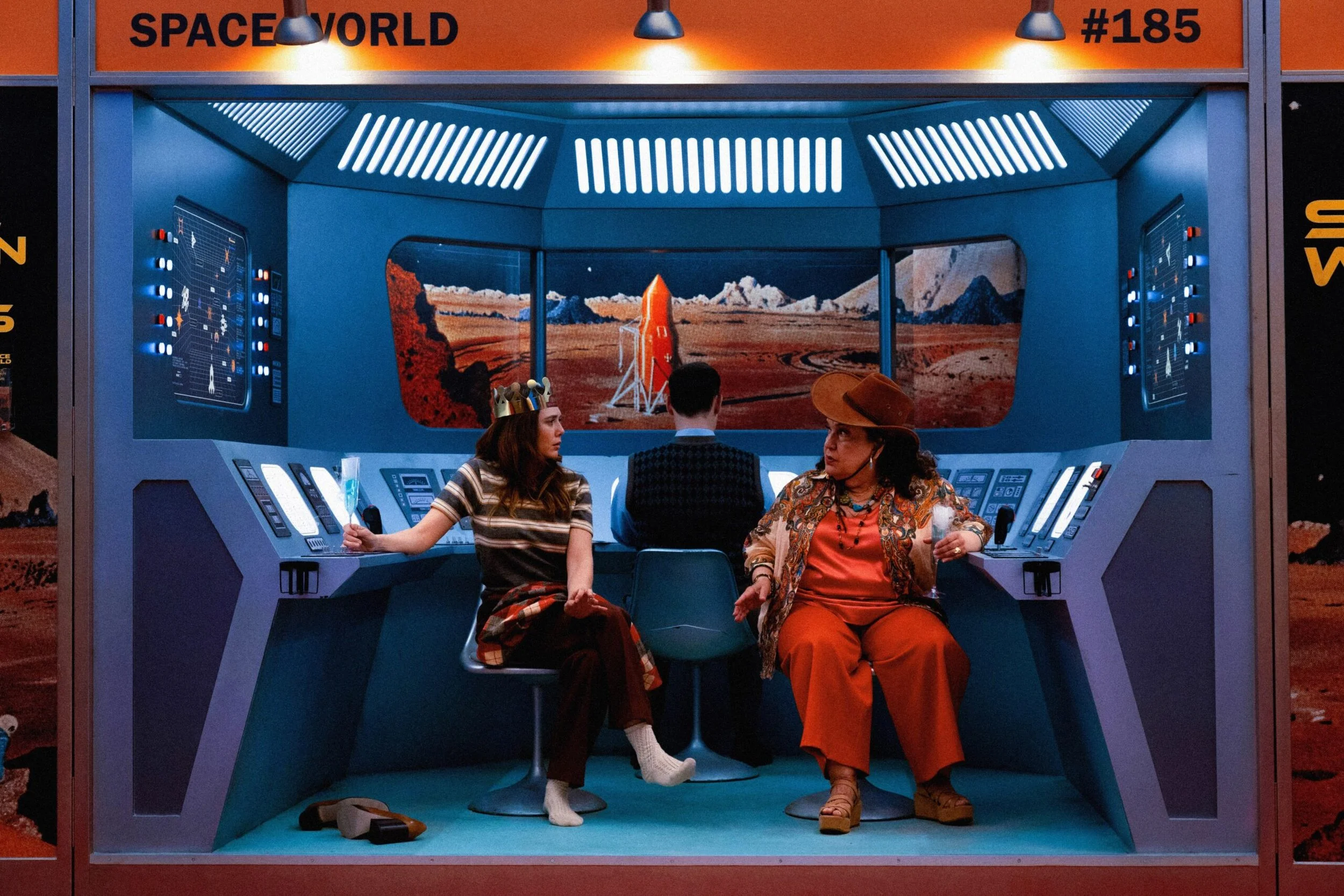
Elizabeth Olsen and Olga Merediz as Joan and Karen
Elizabeth Olson, Miles Teller, and Callum Turner deliver performances that feel like confessions.
No actor in this film is coasting.
Every performance feels like someone cracked open their ribcage and said, “Fine. Look. This is what it’s really like.”
“This is all I am. Please love me anyway.”
The leads play their roles with a kind of restrained desperation — the kind you don’t notice until you look down and realize your hands are gripping the armrests — and it stays with you. It’s equal parts beautiful, brutal, and agonizingly gentle.
Every choice, every glance, every unspoken word feels like it could tilt the world — and maybe it does, even if only in small, curious ways.
It’s in those small, nearly imperceptible moments that Eternity leaves its mark. Before you even realize, the movie sneaks inside you.
And yet, for all its inadvertent heaviness, Eternity never forgets to breathe life into its audience.
It knows when to let the light in, when to offer relief, and when to remind you that even in the shadow of death, people are still ridiculous and warm and tender. I honestly can’t remember the last time I laughed and smiled so hard watching a film in theatres. For a movie about death, the dichotomy of it being both romantic and truly, unforgettably funny is almost poetic.
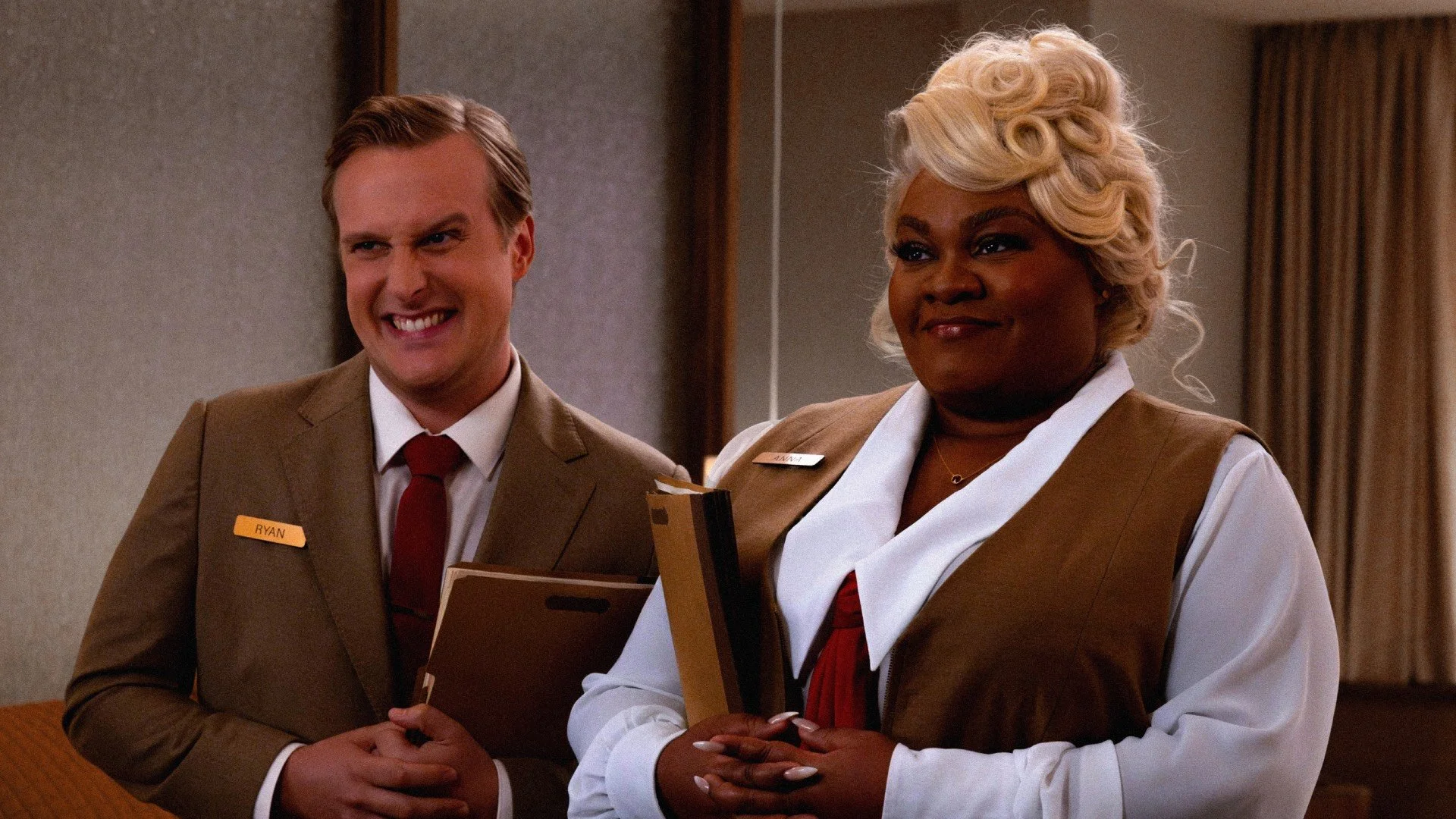
John Early and Da’Vine Joy Randolph as AC Ryan and AC Anna
There’s a moment in Eternity — no spoilers, don’t worry — where everything becomes painfully clear without anyone saying a word. Where the world shifts on its axis. And the audience is left reeling with the decisions of characters to which they have become indistinguishably attached.
Because this film understands the violence of restraint. The heartbreak of almost. The tragedy of poor timing. Even the little moments we encounter that make us laugh so hard we can’t see straight.
And most importantly, the miracle of second chances, even when they arrive too late to be clean. Because life is messy — how could the afterlife be anything but?
It’s a story obsessed with the question:
If you can’t have a perfect life, can you at least have a life that feels true?
You will laugh. You will cry. You will cheer.
You might even fully dissociate for a few seconds.
But the real magic happens after the credits.
You’ll walk out into the night blinking, slightly disoriented, trying to reconnect with reality — because something in you shifted while you weren’t paying attention.
This film doesn’t offer perfection. Perfection is, quite literally, the antithesis of this film and everything it stands for.
In truth, there is only the reality you can live with, and the version of perfect you learn to believe in.
If you see one movie to round out 2025, go see Eternity.
See it with friends.
See it alone.
See it with someone you love — or even someone you shouldn’t.
But be sure to bring tissues, your compassion, and that part of yourself, no matter how small, that still believes stories can heal you — even if it's only temporarily.
Because Eternity isn’t just the movie of the year. It’s the kind of story that lingers like a bruise, glows like a memory, and stays with you long after the lights come up.
This one won't just change you. It’ll burrow under your skin, play your heartstrings like a violin, and rewire your perspective on the restraints and freedoms of ‘forever.’
Sometimes it’s new beginnings and old flames — and the choice to be happy above all else — that gently rewrite what forever really means.
And perhaps you, like your own version of eternity, are infinite.